
What Are Hanging Menu Boards for Restaurants?
When you walk into a restaurant, what’s the first thing you look for? The menu. Before the aroma hits you or the cashier greets you, your eyes scan the space, hunting for what to order. That’s exactly where hanging menu boards come into play—they grab attention, guide decisions, and quietly shape the customer experience.
Why Menu Presentation Matters?
Menu presentation isn’t just decoration; it’s a silent salesperson. A well-designed menu can speed up ordering, reduce confusion, and even increase average order value. Hanging menu boards elevate this concept—literally—by placing menu information directly in the customer’s line of sight.
Types of Hanging Menu Boards
Digital Hanging Menu Boards
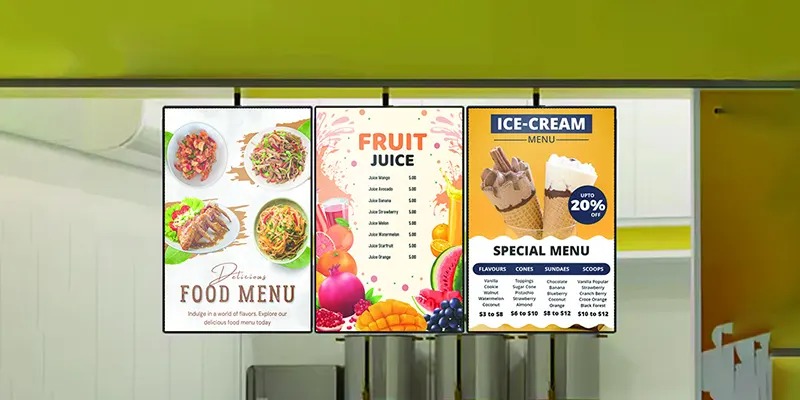
Digital hanging menu boards use electronic displays to present menus dynamically. They are increasingly popular due to their flexibility, visual impact, and ability to integrate with modern restaurant systems.\
LCD Hanging Menu Boards
LCD menu boards are the most common type of digital hanging menu boards. They provide high-resolution visuals, accurate color reproduction, and support for images, videos, and animations. This allows restaurants to showcase food photography, promotional content, and branded visuals alongside menu items.
LCD boards are ideal for restaurants that want a modern, professional look and frequently update menus, prices, or promotions.
LED Hanging Menu Boards
LED hanging menu boards are known for their brightness and visibility, even in high-light environments. They are especially effective in large spaces, food courts, or restaurants with open storefronts where sunlight may reduce screen visibility.
LED boards are energy-efficient, durable, and capable of displaying bold, eye-catching content. They are often used in high-volume quick-service restaurants where clarity and attention-grabbing visuals are essential.
Video Wall Hanging Menu Boards
Video wall menu boards consist of multiple screens combined into a single large display. Suspended from the ceiling, they create a dramatic visual impact and allow for highly flexible layouts.
These boards are ideal for flagship stores, food halls, and large restaurants that want to make a strong visual statement. While more expensive, they offer unmatched customization and brand presence.
How to Design an Effective Hanging Menu Board?
Prioritize Readability Above All Else
Readability is the foundation of an effective hanging menu board. No matter how beautiful the design is, it fails if customers struggle to read it. The menu should be legible from the typical viewing distance, which is usually several feet away while customers stand in line.
Use large, clear fonts and avoid overly decorative typefaces for item names and prices. Sans-serif fonts tend to perform best at a distance. Line spacing should be generous, and text should never feel cramped. A good rule of thumb is this: if customers need to lean forward or squint, the font size is too small.
Use a Clear Visual Hierarchy
A strong visual hierarchy helps customers quickly understand what to look at first, second, and third. Headings, item names, descriptions, and prices should all have distinct visual treatments.
For example, category headings should be the largest or boldest text, item names slightly smaller, and descriptions the smallest. Prices should be clearly visible but not overpower the item names. This structure acts like a roadmap, guiding the eye naturally across the menu and reducing decision fatigue.
Organize the Menu Logically
An effective hanging menu board presents information in a logical order that matches how customers think. Start with best-selling or core items, followed by secondary options and add-ons. Group similar items together so customers can compare choices easily.
Avoid overcrowding the menu with too many items. Fewer, well-presented options often lead to faster decisions and higher satisfaction. If the menu is large, consider splitting it across multiple hanging panels rather than forcing everything into one board.
Choose Colors with Purpose
Color plays a powerful psychological role in menu design. High contrast between text and background is essential for readability. Dark text on a light background or light text on a dark background works best.
Warm colors like red, orange, and yellow are known to stimulate appetite and draw attention, while cooler colors like blue and green can create a calming effect. Use accent colors strategically to highlight promotions, best-sellers, or combo deals without overwhelming the overall design
Key Benefits of Hanging Menu Boards
Hanging menu boards are far more than a design trend—they are a practical business tool that directly impacts customer experience, operational efficiency, and brand perception. Below is a detailed expansion of the key benefits, explaining why so many restaurants are choosing hanging menu boards and how they add measurable value in real-world settings.
Improved Visibility and Readability
One of the biggest advantages of hanging menu boards is their superior visibility. Because they are suspended from the ceiling and positioned above the ordering counter, they naturally fall within the customer’s direct line of sight. This means customers can start reading the menu the moment they step into the restaurant, even before reaching the counter.
In busy environments, wall-mounted or counter menus can easily be blocked by people, equipment, or décor. Hanging menu boards stay clear and unobstructed, ensuring consistent readability during peak hours. Larger font sizes, better spacing, and elevated placement reduce eye strain and confusion, allowing customers to absorb information quickly and confidently.
Better Use of Vertical Space
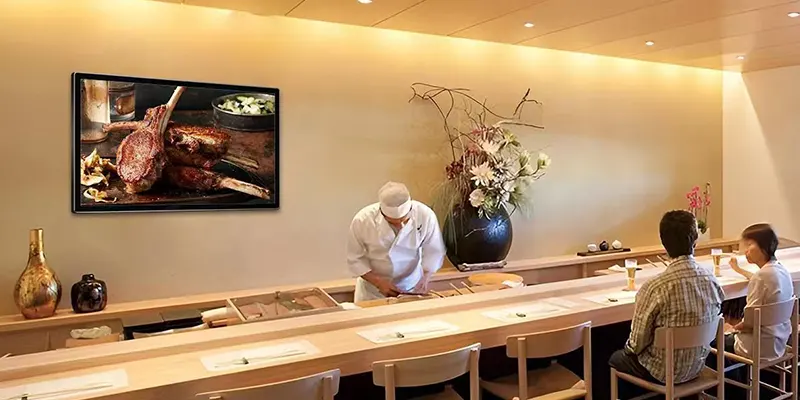
Restaurant space is always at a premium, especially in urban locations. Hanging menu boards take advantage of unused vertical space, freeing up walls for branding, artwork, or functional elements such as shelving and lighting.
By moving the menu off the walls and counters, restaurants can create a cleaner, more organized layout. This not only improves aesthetics but also helps maintain a sense of openness, making smaller spaces feel larger and less cluttered. Efficient use of vertical space is a subtle but powerful way to enhance interior design without increasing square footage.
Faster Ordering and Improved Customer Flow
Clear, visible menus directly influence how quickly customers place their orders. Hanging menu boards allow guests to review options while waiting in line, rather than only once they reach the counter. This pre-decision process significantly reduces hesitation and back-and-forth questions during ordering.
As a result, lines move faster, bottlenecks are reduced, and staff can serve more customers in less time. In high-volume environments like fast-food restaurants and food courts, this improved flow can lead to higher daily sales and a more relaxed atmosphere for both customers and employees.
Enhanced Brand Image and Professional Appearance
First impressions matter, and hanging menu boards make a strong one. A well-designed suspended menu instantly communicates professionalism, attention to detail, and modernity. It shows customers that the restaurant is thoughtfully designed and well-organized.
Design elements such as typography, color schemes, materials, and layout all reinforce brand identity. Whether the style is minimalist, industrial, rustic, or premium, hanging menu boards help visually express what the brand stands for. This consistency builds trust and makes the restaurant more memorable.
Conclusion
Hanging menu boards are more than just a way to display food options—they’re a strategic tool that blends design, functionality, and branding. Whether static or digital, minimalist or rustic, these suspended displays help restaurants communicate clearly, operate efficiently, and leave a lasting impression. If you’re looking to upgrade your menu presentation, hanging menu boards are a smart, future-ready choice.
FAQ
1. What is the main purpose of hanging menu boards in restaurants?
The main purpose is to display menus clearly and visibly so customers can easily view options, make faster decisions, and reduce congestion at the ordering counter.
2. Are hanging menu boards better than wall-mounted menus?
Hanging menu boards often provide better visibility and space efficiency, especially in busy restaurants. However, the best choice depends on the layout and concept of the restaurant.
3. Are digital hanging menu boards expensive?
Digital hanging menu boards have a higher initial cost, but they often save money long-term by eliminating printing costs and allowing instant updates.
4. Can small restaurants use hanging menu boards?
Yes. Hanging menu boards are ideal for small spaces because they use vertical space and keep walls and counters uncluttered.
5. How high should hanging menu boards be installed?
They should be positioned high enough to be visible from a distance but low enough to read comfortably, typically aligned with customer eye level when standing.