
How Digital Displays for Retail Are Gradually Changing In-Store Communication
Digital displays for retail have become increasingly visible in physical stores over the past decade. What once appeared mainly in flagship locations or experimental concepts is now common across supermarkets, specialty shops, and shopping centers. Rather than replacing staff or redefining retail entirely, these displays have taken on a more practical role: supporting daily communication between stores and customers. Their growing presence reflects gradual operational changes rather than sudden technological disruption.
1. From Static Signage to Adaptable Communication Tools
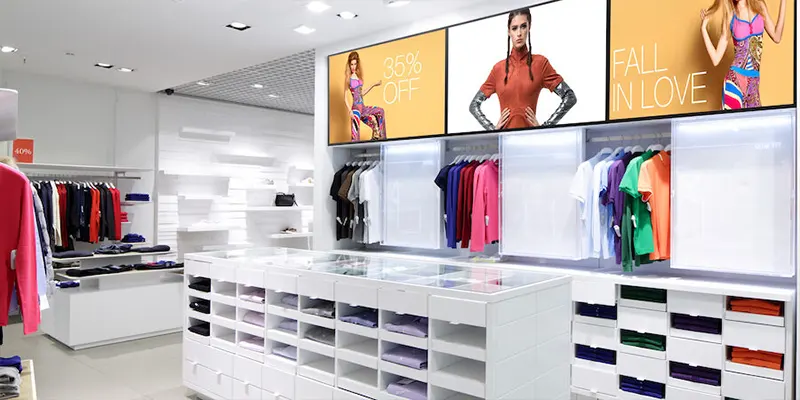
Traditional printed signage has long been a basic part of retail environments. However, it is limited by fixed content and slow update cycles. Digital displays for retail address these constraints by allowing content to be changed remotely and in near real time. Retailers use this flexibility to adjust pricing, highlight short-term promotions, or communicate service information without physically replacing materials. Over time, this adaptability has shifted displays from decorative elements to functional tools embedded in store operations.

2. Supporting Consistency Across Multiple Store Locations
For retailers operating multiple locations, maintaining consistent messaging has always been challenging. Printed materials can quickly become outdated, especially during seasonal changes or pricing adjustments. Digital displays for retail make it easier to synchronize content across stores while still allowing local customization when necessary. Centralized management helps reduce errors and ensures that customers receive accurate information regardless of location.
3. Influence on Customer Flow and In-Store Behavior
Digital displays are often positioned at entrances, endcaps, or checkout areas where customer attention naturally pauses. In these locations, displays can guide movement, highlight key products, or clarify next steps in the shopping process. Retailers report that clear visual information reduces hesitation and repetitive questions, particularly in high-traffic environments. While the impact may be subtle, improved clarity can contribute to smoother in-store flow and a more predictable customer experience.
4. Reliability as an Operational Consideration
As digital displays for retail become part of everyday operations, reliability has emerged as a central concern. Screens are frequently expected to operate for long hours with minimal downtime. Failures not only interrupt messaging but can also create confusion or reduce customer trust. As a result, retailers increasingly focus on stability, ease of maintenance, and long-term performance rather than experimental features or complex configurations.
5. Integration With Broader Retail Systems
In more advanced deployments, digital displays for retail are connected to inventory systems, scheduling tools, or promotional calendars. This integration allows content to reflect real-time conditions such as stock availability or time-specific offers. While not all retailers adopt full integration, those that do often view displays as part of a broader digital infrastructure supporting store management rather than isolated visual elements.
Conclusion
Digital displays for retail are no longer treated as optional enhancements reserved for select locations. Their value lies in practical communication, consistency, and operational support rather than visual novelty. As physical retail continues to adapt to changing customer expectations, digital displays are increasingly regarded as long-term infrastructure that helps stores remain responsive and organized.
FAQ
1. What types of retail environments commonly use digital displays?
Digital displays are widely used in supermarkets, apparel stores, electronics retailers, and shopping centers.
2. Are digital displays for retail mainly used for advertising?
No. While promotions are common, many displays focus on pricing, guidance, and service information.
3. How do digital displays help multi-location retailers?
They allow centralized updates while maintaining consistent messaging across stores.
4. Is reliability more important than advanced features?
In most retail settings, stability and ease of maintenance are prioritized over complex functions.
5. Do digital displays need system integration to be effective?
Basic setups work independently, though integration can improve responsiveness and accuracy.