In a world driven by instant gratification, customers no longer tolerate long waits just to place an order. Speed has become the baseline expectation, not a premium feature. Restaurants that move faster serve more guests, reduce congestion, and improve satisfaction. Advertising displays play a critical role by presenting clear, visual menus and promotions that help customers decide quickly, streamline ordering, and keep tables turning efficiently.
Restaurant Chain's Challenge
Background of the Restaurant Chain
The chain had grown rapidly, adding advertising displays faster than its processes evolved. While early success was driven by food quality and branding, operational systems hadn’t kept pace with increased foot traffic. Each new store inherited the same inefficiencies, multiplying the problem.
Symptoms of the Problem
What made the issue particularly challenging was that no single failure point existed. Instead, small delays stacked up across the ordering journey. Advertising displays can effectively solve this difficulty and ensure the entire process runs smoothly.
Customer Complaints and Negative Reviews
Negative reviews weren't just complaints; they were warnings. Many mentioned choosing competitors during busy hours or switching to delivery apps instead of dining in. These comments revealed that customers still liked the brand—but were actively avoiding friction. The key to solving the advertising display problem lies in improving service efficiency. Even during peak hours, customers can complete self-service transactions through self-service options and signage, thereby increasing customer satisfaction and repurchase rates, and ultimately improving the overall service quality of the store.
Why Traditional Solutions Were Not Enough?
Hiring More Staff
Adding staff increased headcount but not clarity. Without fixing information flow, new hires simply joined the same inefficient system. Management realized that labor alone couldn’t solve a communication problem rooted in outdated tools.
Kitchen Expansion
Kitchen output wasn’t the limiting factor. Food prep speed exceeded order intake speed, meaning investment in kitchen expansion would sit underutilized.
Rising Costs Without Guaranteed Results
Both staffing and construction required long-term commitments. Leadership needed a solution that was flexible, scalable, and measurable—without locking them into irreversible expenses.
Introducing Advertising Displays as a Strategic Solution
What Are Advertising Displays in Restaurants?
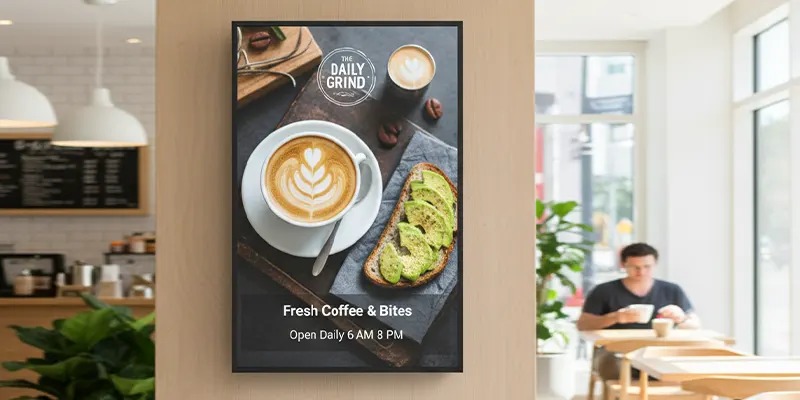
Advertising displays act as dynamic communication hubs. They guide customers visually, reinforce promotions, and eliminate ambiguity. Unlike static signage, they adapt instantly to operational needs, time of day, and customer behavior.
Why Digital Displays Make Sense
Digital displays centralize information delivery. Instead of staff repeating details verbally, the system communicates consistently and simultaneously to everyone in the space. This dramatically reduces friction and improves flow.
Planning the Advertising Display Strategy
Choosing the Right Display Locations
Placement Advertising Displays strategy was based on behavioral psychology. Screens were positioned where customers naturally pause or look up, ensuring maximum visibility without distraction. This alignment between design and behavior was key to effectiveness.
Designing Content for Speed
Every design choice prioritized clarity over creativity. The goal wasn’t decoration—it was decision acceleration.
Visual Hierarchy and Readability
Items were arranged to guide the eye naturally from top sellers to modifiers. This reduced Advertising Displays scanning time and improved comprehension within seconds.
Real-Time Menu Updates
Live updates eliminated awkward conversations about unavailable items and prevented order changes mid-process, saving time and reducing frustration.
Why Advertising Displays Are a Competitive Advantage?
Standing Out in a Crowded Market
Modern visuals signal efficiency before a word is spoken. Advertising displays create a strong first impression by showing clear menus, promotions, and order flow at a glance. This visual clarity builds trust, reduces customer hesitation, and helps restaurants appear faster, more organized, and more professional than nearby competitors.
Future-Proofing Restaurant Operations
The system remains adaptable as customer expectations evolve. Advertising displays allow instant menu updates, flexible promotions, and seamless integration with new technologies. This adaptability helps restaurants respond quickly to changing trends, scale across locations, and maintain operational efficiency without costly reprints or workflow disruptions.
Customer Case Study

The customer adopted outdoor advertising displays to attract foot traffic and communicate promotions in real time. The high-brightness screens delivered clear visibility in all weather conditions, increasing brand exposure and walk-in conversions. As a result, the business strengthened its street presence, improved campaign flexibility, and achieved measurable growth in customer engagement and in-store visits.
Conclusion
Advertising displays proved to be more than a visual upgrade—they became a strategic solution to operational inefficiencies. By improving order clarity, speeding up customer decisions, and supporting future scalability, the restaurant chain transformed slow turnaround into a competitive strength. The result was faster service, better customer experiences, and a system built to grow with evolving expectations.
FAQs
1. How do advertising displays improve order turnaround time?
Advertising displays present clear, real-time menu information that helps customers decide faster and reduces the need for staff explanations, allowing orders to move through the system more efficiently.
2. Are advertising displays suitable for all types of restaurants?
Yes, advertising displays work well for fast-food, fast-casual, and casual dining restaurants. They can be customized to match different menus, service styles, and customer volumes.
3. Do advertising displays require major changes to existing systems?
Most modern advertising display solutions integrate easily with existing POS systems, minimizing disruption while improving accuracy and operational flow.
4. Can advertising displays be updated quickly?
Yes, content can be updated in real time across one or multiple locations, making it easy to adjust menus, promotions, or pricing instantly.
5. What is the long-term benefit of using advertising displays?
Beyond faster service, advertising displays support scalability, consistency, and adaptability, helping restaurants stay competitive as customer expectations and technology continue to evolve.