
Using LCD Signage Display in Transportation Hubs: Delivering Real-Time Information
Ever stood in a crowded airport staring at a tiny, outdated board, trying to decode your flight status? We've all been there—confused, stressed, and racing against time. This is where LCD signage displays step in like digital superheroes. In today's fast-moving world, transportation hubs need instant, clear, and accurate communication. LCD screens provide exactly that—real-time information that keeps passengers informed, calm, and moving in the right direction.
From airports and train stations to subways and bus terminals, LCD signage is transforming how travelers interact with public spaces. It's no longer just about showing schedules—it's about creating a seamless travel experience.
1. What Is LCD Signage Display?
LCD (Liquid Crystal Display) signage refers to digital screens that use liquid crystals to display high-resolution visuals. These screens are widely used in public spaces due to their clarity, durability, and energy efficiency.
Key Features of LCD Screens:
LCD signage offers crisp visuals, bright colors, wide viewing angles, and low power consumption. They're built for 24/7 operation and can handle heavy traffic environments without missing a beat.
2. How LCD Differs from LED and Projection?
While LED walls are larger and more expensive, LCD displays are cost-effective and perfect for indoor transport hubs. Compared to projectors, LCD screens provide sharper images and work well in bright lighting conditions.
3. Benefits of LCD Signage in Transportation Hubs
Improved Passenger Experience: Clear directions, real-time updates, and visually engaging content reduce stress and improve satisfaction.
Operational Efficiency: Staff no longer need to manually update boards. Everything is controlled centrally through a CMS.
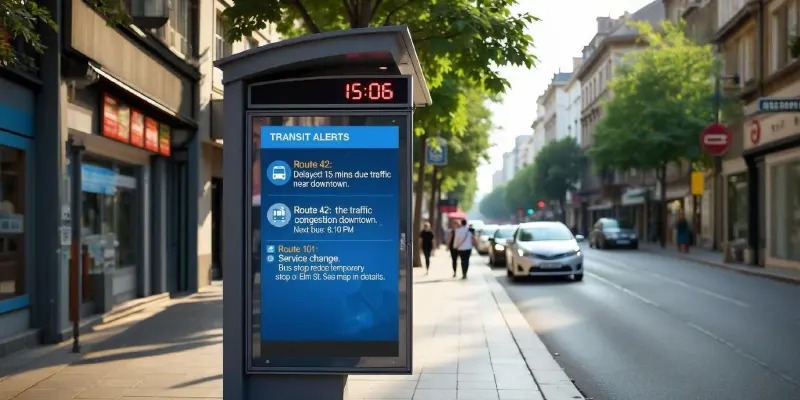
Enhanced Safety and Security: Emergency alerts and evacuation instructions can be displayed instantly.
Revenue Opportunities: Advertising on LCD screens creates new income streams for transport authorities.
4. Types of LCD Signage Displays Used in Transportation
LCD signage comes in several forms, each designed to support fast, clear communication in busy transportation hubs.
Arrival and Departure Boards:Show real-time schedules, delays, gate changes, and boarding status. These are the main information source for passengers.
Wayfinding and Directional Screens:Guide travelers to gates, platforms, exits, and services using maps, arrows, and simple directions.
Emergency and Safety Alert Displays:Instantly switch to emergency messages with bold text and symbols to guide people during critical situations.
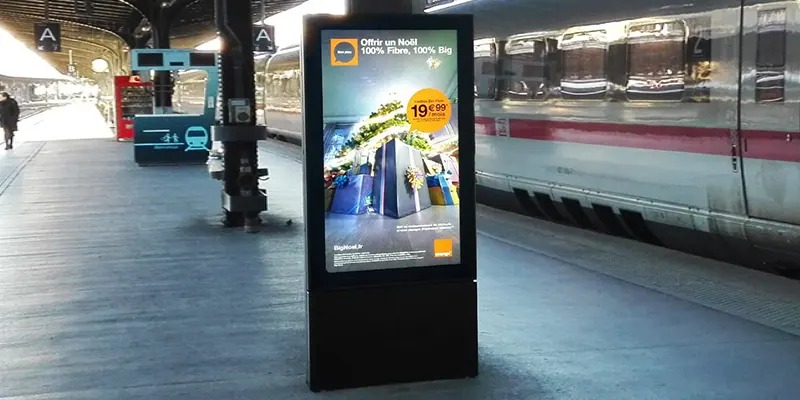
Advertising and Promotional Displays:Display ads, travel offers, and local promotions, creating extra revenue for transport operators.
Interactive Information Kiosks:Touchscreen displays that allow passengers to search routes, maps, and schedules independently.
Queue and Service Status Screens:Show boarding groups, wait times, and service updates to improve crowd flow and reduce confusion.
5. How LCD Signage Improves Passenger Flow?
LCD signage helps keep travelers moving by providing clear, real-time directions, platform updates, and boarding information. When passengers know exactly where to go, they spend less time wandering and blocking walkways. These displays can also change routes during busy periods, guiding people away from crowded areas to reduce congestion. Queue and wait-time screens further organize lines, making boarding and security checks faster.
With simple visuals, icons, and color cues, LCD signage guides people smoothly—even across language barriers—creating a safer, more efficient flow throughout the transportation hub.
6. Choosing the Right LCD Signage Solution
Selecting the right LCD signage system is crucial for delivering clear, reliable information in transportation hubs. The right solution should not only fit the space but also support real-time updates and long-term performance.
First, consider the screen size and resolution. Large terminals need bigger, high-brightness displays that can be read from a distance, while smaller areas may only require compact screens. High resolution ensures text and graphics remain sharp and easy to read.
Next, focus on software compatibility and content management. A good LCD signage system should integrate with existing transport management systems and allow centralized, real-time content updates through a user-friendly CMS.
Durability and reliability are also essential. Transportation hubs operate 24/7, so displays must be commercial-grade, heat-resistant, and built for continuous use with minimal downtime.
Finally, think about maintenance, scalability, and support. Choose a solution that is easy to service, can expand as your network grows, and includes strong technical support to ensure smooth operation over time.
7. Conclusion
LCD signage displays are no longer optional—they're essential. In transportation hubs, where every second counts, real-time information is the key to smoother journeys, happier passengers, and more efficient operations. LCD signage isn't just a screen—it's a communication lifeline.
FAQs
Q1. What is LCD signage used for in transportation hubs?
It provides real-time updates, directions, and safety information.
Q2. How does LCD signage improve passenger experience?
It reduces confusion, provides clarity, and saves time.
Q3. Is LCD signage energy efficient?
Yes, it consumes less power than traditional displays.
Q4. Can LCD signage show emergency alerts?
Absolutely, alerts can be displayed instantly.
Q5. Is LCD signage customizable?
Yes, content, layout, and branding can be fully customized.